How Sevenstar transported two William Fife masterpieces across the Atlantic and safely home again.
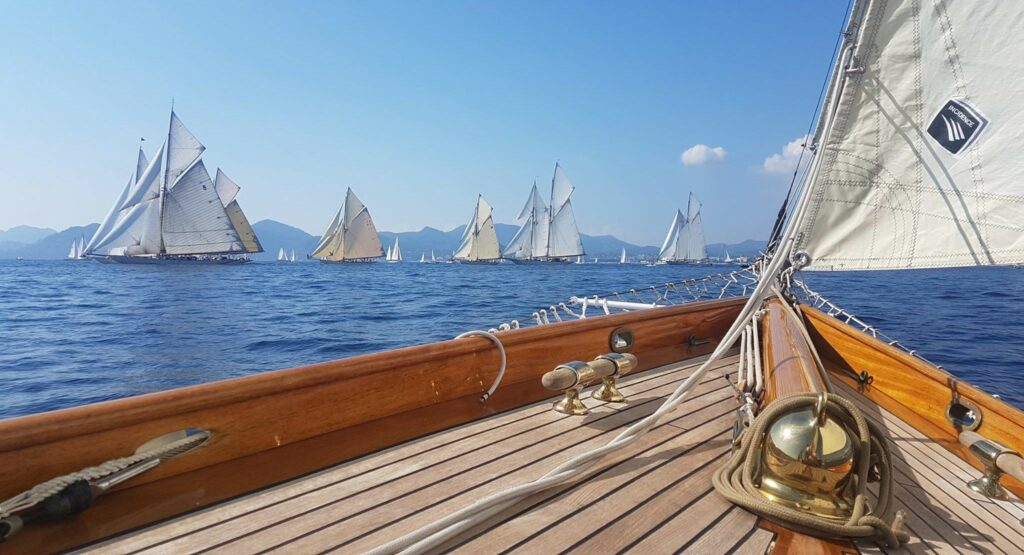
When the classic yachts SY Tuiga (1909) and SY Viola (1908) arrived on the American East Coast in the summer of 2026, visitors saw two elegant William Fife designs sailing alongside some of the world’s most celebrated historic yachts. What many did not see was the complex logistics operation that made their participation possible.
The flagship of the Yacht Club de Monaco and her slightly older sister yacht, Viola, had not crossed the Atlantic under sail. Instead, both yachts traveled aboard transport vessels operated by Sevenstar Yacht Transport, ensuring they arrived ready to participate in an extensive program of events in Newport, New York, and along the American coast.
The celebrations surrounding the United States’ 250th anniversary provided the backdrop for their visit, but the transport story itself reflects something far more universal: how modern logistics can help preserve maritime heritage by keeping historic yachts active without unnecessarily subjecting them to the demands of an ocean crossing.
More than moving a yacht
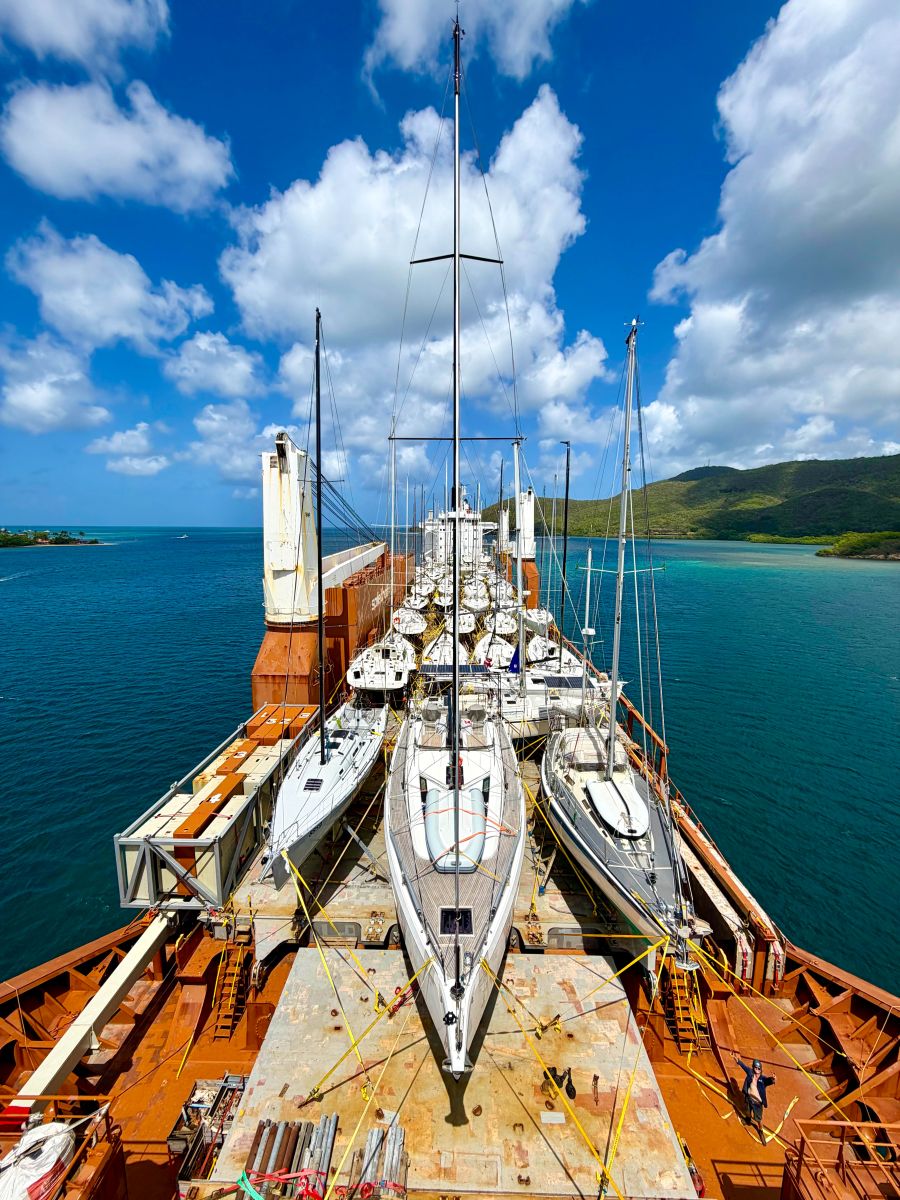
Transporting a modern sailing yacht is a technical exercise. Transporting a century-old wooden yacht requires a different level of preparation.
Both Tuiga and Viola are regarded as important examples of William Fife III’s work and continue to race and sail actively more than a century after their launch. Their owners and custodians are not merely managing boats. They are caring for pieces of living maritime history.
For Sevenstar Sales Manager Valerio del Becaro, that distinction defines the entire project. “For classic yachts, the objective is never simply to get from one port to another,” he explains. “The real challenge is enabling these yachts to continue sailing, racing, and being seen by future generations while protecting them from unnecessary wear and risk.”
A transatlantic crossing remains one of sailing’s greatest adventures, but it also subjects a yacht to weeks of continuous stress. For historic yachts, that exposure affects rigging, sails, machinery and structures that may be impossible or prohibitively costly to replace. Professional transport allows owners to reserve those miles for racing, cruising and public appearances rather than for delivery passages.
Planning before the yacht reaches the dock
Long before either yacht arrived alongside the transport vessel, Sevenstar’s engineering team was already preparing the operation.
According to Valerio, the process began with extensive exchanges among Sevenstar, the captains, and the yacht representatives. “We received drawings and technical information from the yacht’s crew, after which our engineers prepared detailed lifting, stowage, and securing plans. Every stage of the operation is planned in advance. The goal is to eliminate surprises on loading day.”
For Tuiga, this was far from the first collaboration with Sevenstar. The yacht has previously traveled aboard Sevenstar-operated vessels on several occasions, making her something of a repeat customer.
Yet familiarity never leads to shortcuts
Every transport requires a new engineering review based on the yacht’s current condition and voyage requirements. Particular attention is paid to lifting arrangements, weight distribution, clearance requirements, and securing methods. Detailed cradle and lashing plans are prepared to ensure the yacht remains fully stable throughout the ocean passage.
One of the most notable aspects of the operation was Sevenstar’s ability to transport Tuiga and Viola with her mast still standing.
For many classic yachts, the mast is not merely a functional component but an integral part of the yacht’s historic identity. Removing and reinstalling a large wooden mast poses handling risks and requires extensive labor. By keeping the rig in place, Sevenstar minimized intervention while ensuring the yacht remained ready for immediate use after discharge.
The decision held particular significance for Tuiga. Only a year earlier, the yacht had suffered a dramatic dismasting at a regatta in Palma de Mallorca, necessitating the complete replacement of her mast. After an extensive rebuild, she returned to service and was prepared for her Atlantic crossing to Newport-RI.
Rather than relying on standardized supports, Sevenstar uses custom-designed transport cradles. These cradles distribute loads across the hull and are certified to Lloyd’s Register standards. For historic wooden yachts, where pressure points and structural characteristics differ significantly from those of modern production yachts, proper support is essential.
The objective throughout remains remarkably simple: the yacht should arrive in exactly the same condition as it was in when entrusted to the transport team.
Precision on the waterfront
Once the planning phase is complete, responsibility shifts from the engineering team to the dockside operation.
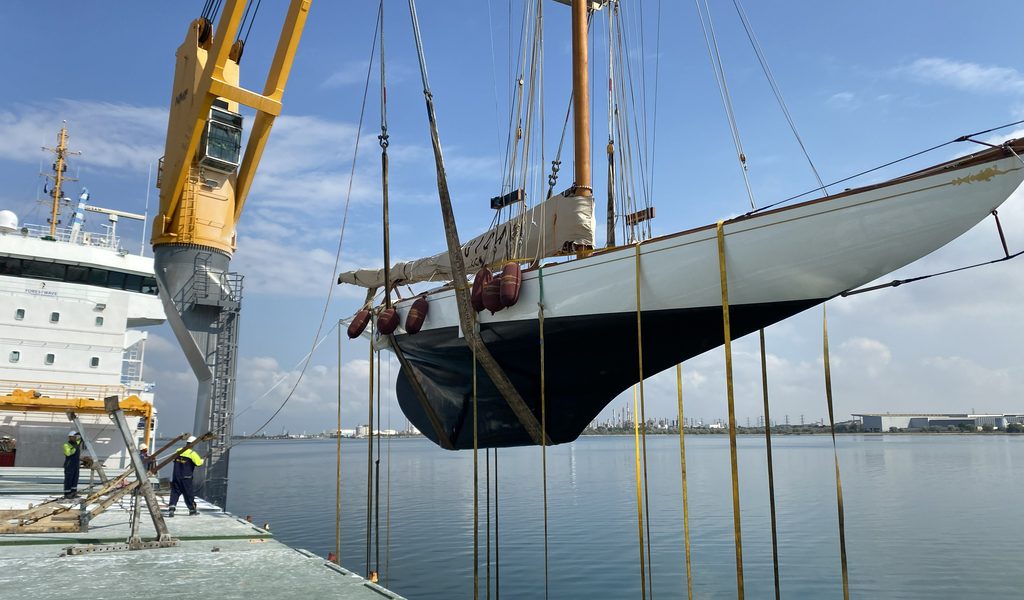
Sevenstar Loadmaster Guido oversaw the loading of Tuiga in Newport aboard MV Happy Dover for her return voyage to Europe. His role was to oversee the lifting, positioning, and final securing of a yacht representing more than 100 years of maritime history.
“Because of her age, lifting Tuiga feels different from loading a modern sailing yacht,” says Guido. “We load yachts every day, but when you’re dealing with a yacht that has been sailing for more than a century, you naturally become even more careful.”
At the same time, he notes that Tuiga inspires confidence immediately. “As soon as you step on board, you can see how well she is built. She is an old yacht, but she is also remarkably robust.”
Despite that strength, the operation demanded close attention
One of the challenges stemmed from the shape of Tuiga’s keel. Because the keel sits at a pronounced angle, special attention was required to keep the yacht level once aboard the cargo vessel. Correct alignment was important not only for aesthetics but also for practical reasons, such as deck drainage during the voyage.
Before the yacht was lifted, divers entered the water to verify the precise location of the lifting slings under the hull.
“We used two divers to confirm the positions of the lifting belts beneath the yacht,” Guido explains. “We wanted to be absolutely certain that no sensitive parts of the hull were affected.”
Only after the final checks were completed did the yacht leave the water and begin her carefully controlled ascent onto the ship.
Once aboard, Tuiga was secured with keel supports, additional cradle structures, and supplementary support at the bow and stern. This arrangement ensured stability throughout the Atlantic crossing while respecting the historic hull’s specific needs.
A round trip built around a season
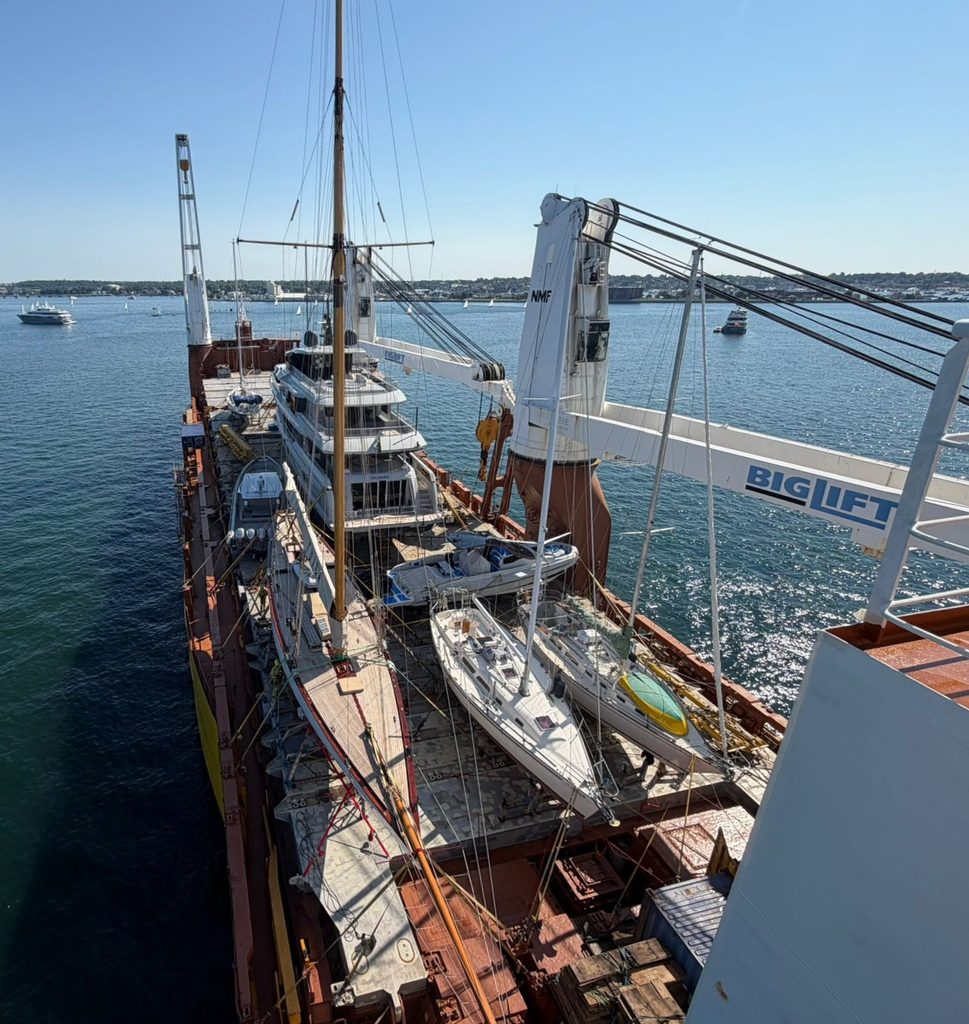
The voyages of Tuiga and Viola also illustrate a growing trend in the yacht community: planning transport for an entire sailing season rather than for a single trip.
Sevenstar arranged a comprehensive round-trip program between the Mediterranean and Newport-RI. This provided the Yacht Club de Monaco with certainty regarding arrival and return dates and enabled the club to build an extensive American campaign around a fixed transport schedule.
Instead of arriving after a demanding Atlantic crossing, both yachts were able to begin their program immediately after discharge. For owners and custodians of classic yachts, this increasingly offers the best balance between preservation and participation. The yachts continue to sail extensively, but the most demanding delivery miles are handled by specialist carriers.
Protecting a living legacy
The story of Tuiga and Viola is not really about cargo ships, cranes, or logistics. It is about keeping extraordinary yachts operational in today’s world.
Professional yacht transport enables owners, clubs, and preservation organizations to participate in international events while reducing unnecessary strain on yachts that have already endured more than a century of sailing history.
For Sevenstar, that responsibility extends beyond transportation itself. As Valerio del Becaro puts it: “We’re not moving cargo. We’re helping owners protect something that cannot be replaced.”
For Guido Seeleman, watching Tuiga safely depart the dock aboard MV Happy Dover was a reminder of why such projects matter. “A yacht like Tuiga deserves to keep sailing for another hundred years. If we can help make that possible, we’ve done our job.”
Because maritime heritage is preserved not by keeping historic yachts ashore, but by keeping them where they belong: on the water, under sail and continuing the stories they began more than a century ago.

welcome@sevenstar-yacht-transport.com
MATTHIEU LE BIHAN : +33 631 892 653 – matthieu@sevenstar-france.com
ELODIE LE BLEVENEC : +33 671 841 513 – elodie@sevenstar-france.com
Texte et Photos : SEVENSTAR YACHT TRANSPORT
Summary N°1